

Recycle Christmas trees into handmade incense sticks to rekindle the Christmas spirit
The scent of a Christmas tree will make you feel the Christmas spirit even with your eyes closed. Every Christmas, many shopping malls bring in cypress, fir, pine, and other species for decoration, creating photo booths that are both visually and olfactoryly captivating. However, after the holidays, these trees become waste wood, destined for landfill. Isabelle, who owns her own incense brand, came up with the idea of recycling these abandoned trees and creating Christmas incense sticks, continuing this romantic atmosphere. Even without a Christmas tree, you can still rekindle the Christmas fragrance in your home!

The beauty of an incense stick beyond its religious significance
Throughout cultural history, incense sticks have always been part of religious rituals. Isabelle said, "Like most people, I believe incense sticks inherently carry religious connotations. They used to be used for worship, and the first incense sticks I burnt in the new year are probably the most profound memories." During the pandemic, Isabelle's cat began to experience emotional distress, exhibiting behaviors such as spinning, pacing, and suddenly opening its mouth to breathe heavily. She realized her anxiety was affecting her pet. "I gradually learned about the incense usage habits of different countries online, and discovered that many countries use incense to purify the space and soothe emotions." So she began researching incense for pets, and the launch of her incense sticks received positive feedback from users. She then understood that the purpose of burning incense sticks is no longer simply religious, but a true part of daily life. This also marked the beginning of Isabelle's desire to use wood to tell stories.

Recycling waste wood Christmas trees to recreate the sense of Christmas ritual
Life needs a sense of ritual, and Christmas needs a Christmas tree. "Every year, the Christmas tree's mission quietly ends after the holidays, but this year, the Christmas story won't end there." Isabelle began researching incense during the pandemic. In April of this year, she participated in an event at the Hanami Museum and discovered the innovative concept of "adopting abandoned plants." She conceived the idea of using these abandoned plants to create incense sticks, extending their lifespan. "After Christmas, Christmas trees are usually abandoned," Isabelle said. "They grow for decades, but only last one season, which is a bit of a shame. I wanted to give each piece of wood a second life." So she partnered with the Hong Kong Timber Depot, an organization that specializes in recycling wood, such as branches broken by typhoons and wood used in exhibitions. "We used noble fir wood recycled in 2022 as the base and created six Christmas-themed incense sticks, including scents like Christmas tree, mulled wine, and Christmas cake, to rekindle the Christmas spirit," she said.

Handmade is more like cooking than experimenting
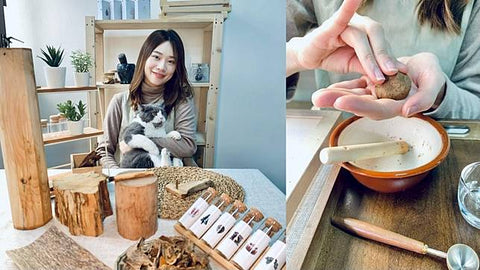
Incense stick making techniques are not restricted by religion, only by the type of wood used. Isabelle explains, "Incense sticks are often made from plant parts, including roots, stems, and leaves. Air-drying, frying, or steaming enhances the inherent flavor. Then, it's pulverized and ground. Sticky powders made from tree bark, such as elm bark powder or nanmu wood powder, are added to create a fragrant paste, which is then pressed into incense sticks." It turns out that incense also comes in various shapes, such as Thai tower incense and Japanese incense sticks. Isabelle explains, "Ancient people liked to wear incense sticks around their waists. These had a fragrance-diffusing effect and were even used as tokens of love. Since they don't require ignition, they can incorporate more floral materials, resulting in a more subtle scent without the odor of burning."


Making handmade incense sticks is no simple task; it's more like cooking than experimentation. Isabelle explains, "When I first started learning to make incense, I was quite spontaneous. For example, I used a unit of 10. However, because each tree has different densities, oil content, and even wood structure, the proportions were off! Later on, I learned to use a more scientific method of measurement, grinding and sifting to achieve a uniform density for the wood."

Learn about the stories told by incense wood
Incense sticks are primarily made from wood. Previously, most incense sticks were single-strength, using only one type of wood, resulting in a simple, pure aroma. Isabelle, a devoted incense expert, enjoys creating complex blends, mixing four to six types of wood, hoping to achieve varying levels of aroma and even conjure up diverse health benefits. To tell a story with wood, one must first understand its characteristics. The properties and benefits of each incense stick are gradually shaped by its growing environment, allowing for extreme variations in scent. Isabelle explains, "For example, sandalwood is primarily produced in Australia, India, and Indonesia. Because its aroma derives from the oily oils of the tree, Indian sandalwood is more pronounced and rich, with a prominent fruity aroma, while Australian varieties have a more refined and elegant aroma. There's also a wide range of price fluctuations."

Peruvian palo santo has a creamier, richer texture and a richer, more layered quality. Thuja, a plant that grows on cliffs, has a calming fragrance and is popular in Taiwan for pillows. Palo santo can only be used six to fourteen years after its natural death and is also used to purify crystals. Isabelle explains, "The scent of incense wood can vary depending on its origin, seasonal climate, and other factors. Each tree is so unique."

Agarwood Fragrance Search: Hong Kong's Fragrant Souvenir Dream
One of the reasons Hong Kong is called Hong Kong is because of its abundance of native agarwood, a precious local tree species. Isabelle explains, "Agarwood itself is not valuable, but when damaged, such as by insect bites, it secretes resin, which then becomes an incense material. This process, called agarwood formation, takes three to seven years. In the past, Hong Kong also had many agarwood trees, which gave rise to an agarwood harvesting industry. Although felling agarwood trees is now prohibited, agarwood trees can still be found at Kadoorie Farm and Taikoo Place in Hong Kong, but they are only used for ornamental purposes."
Everyone has dreams, and Isabelle, in her incense-making career, has her own ambitions. Although large-scale agarwood cultivation has ceased in Hong Kong, she hopes to become the incense of Hong Kong. "It's clearly called Hong Kong," she says, "and I want to carry on Hong Kong culture, turning incense sticks into a souvenir of Hong Kong."

For more details, please visit LINE TODAY


Comments (0)
There are no comments for this article. Be the first one to leave a message!