

Thanks to #明报mingpao for reporting our entrepreneurial story
The poetic combination of local herbs and plants: Local modern incense creates a diverse Hong Kong flavor
What do tears taste like? Hui'an agarwood, Indian sandalwood, and Arabian frankincense. Sandalwood from three different places, with a touch of sweetness, represents "no thoughts." And what about amulets? Omotesando, originating from Japan, naturally use Japanese cypress wood, infused with vanilla, tangerine peel, and other ingredients, creating a spicy, yet sweet and sour experience.
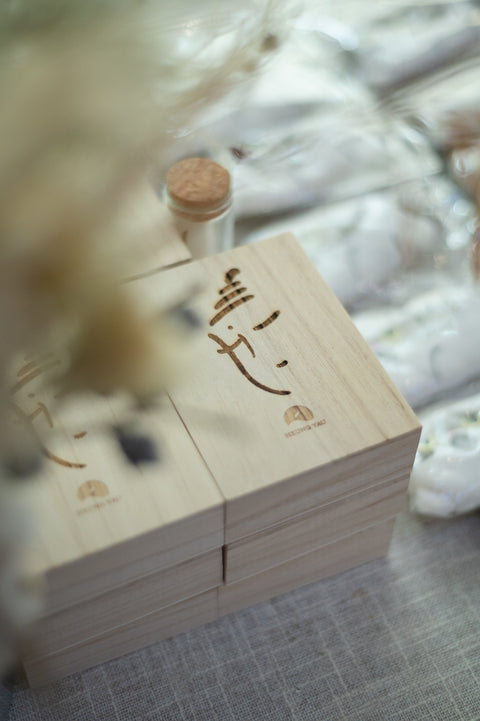
Braving the scorching rain, I pushed open the door of the studio of local incense brand Heung Yau. The aroma of woods hit me, dispelling the dampness that washed over me. Amidst the patter of rain and the wispy smoke, I listened to founders Isabelle Cheng and A-Chai Lee share stories about incense. My eyes drifted to a wooden box nearby. Inside, I found incense sticks, an incense holder, and a short poem: "Hong Kong, a port of incense."
Burning incense to heal people and cats amidst the pandemic
Flash forward to 2020. The city is silent, as if shrouded in a black rain. Isabelle graduated from City University's School of Creative Media. "The COVID pandemic hit, and everything was interrupted," she said. Graduation effectively meant unemployment. While searching, 2022 arrived in the blink of an eye. Anxiety permeated the house, leaving Isabelle unable to sleep. Even her cat, Crab, was infected. "He'd start spinning in circles, drooling, and panting at home," she said.
At a friend's suggestion, Isabelle started lighting incense sticks. Initially, she did so for meditation, but later discovered that the aroma also gave her pets a sense of peace. "I found it so magical! I realized that burning incense not only helps me, but also my pets." Eager to share the healing power of incense with others experiencing similar experiences, Isabelle entered the "Hong Kong Top Ten Craftsmen Awards," a prestigious event in the cultural and creative industries. The "Incense Hill" brand was officially launched, and she subsequently won the sixth "Hong Kong Top Ten Craftsmen Awards."
During our visit, Crab and his other kitten were playing and frolicking, occasionally jumping onto the table and circling around the incense holder. "It was only when I was learning incense making from a local teacher that I learned that Hong Kong's name stems from agarwood and the incense industry," Isabelle said, petting the cat. This revelation fascinated her. "Hong Kong and incense are so closely connected. Could incense become a local souvenir?" She placed her hopes on "Incense Hill," "Incense Hill is a small hill surrounded by fragrance, a metaphor for Hong Kong."
Hong Kong—If "incense" refers to the fragrance of native agarwood, and "Hong Kong" is the "port" of "port," a wave of doubt inevitably arises: If incense is so closely associated with Hong Kong, why doesn't the city have a well-known "incense culture" today? Take, for example, Japan's "Kodo" (こうどう), where many can discuss the "Six Kingdoms and Five Flavors" with eloquence. Or perhaps it's like the ancients, like Qu Yuan, who fashioned clothes from lotus leaves and skirts from lotus flowers. A Cai, who has traveled extensively to learn incense making, says this "neglect" is actually a form of luxury. "The most beautiful agarwood is found in tropical and subtropical regions like Hainan Island, Hong Kong, and Vietnam." In the past, large quantities of incense wood from the Lingnan region were sent as tribute to the Central Plains, and ancient Chinese used it for laundry and showers. "Compared to incense culture, ancient China's use of incense was more immersive." In modern times, incense has been viewed as a "religious element," often dismissed and ignored, leaving incense culture nowhere to be found. But in Japan, incense materials are rare and precious. "Because they are so valuable, they are cherished" and "lighting a small stick of incense is already a rare opportunity." Therefore, the "art of incense" was derived, and incense materials were carefully developed.
Hong Kong, once a production center and port, has a climate unsuitable for incense making. Isabelle explains that drying the incense sticks is a crucial step in the production process. This involves air-drying the rolled incense paste. "You can't dry it in direct sunlight, like drying salted fish. You need to dry it in the shade, naturally in the shade, to dry thoroughly. However, Hong Kong's humid climate makes the weather unpredictable: windy one day, rainy the next. "It's difficult to predict and calculate the time required. Even with a dehumidifier, things can get frizzy."
Every flavor has a story about wood
Walking into the incense-making room, a bag of Taiwanese snacks called "Guai Guai" (a type of snack) is placed on top of a machine that compresses incense sticks, purchased from mainland China. Ah Cai laughed and explained that before making incense, he worked in the film and television industry. Whenever his equipment wasn't functioning properly, he'd place a bag of "Guai Guai" on the machine, hoping it would behave properly. The incense-making machines are quite powerful, causing them to trip from time to time, hence the need for "Guai Guai." A variety of woods and herbs are stacked nearby, each labeled with their origin: Australian sandalwood, Singapore agarwood, Peruvian palo santo, California white sage... It resembles a world map of incense materials. Ah Cai continued, explaining that the numerous raw materials need to be ground into a powder, then mixed with incense powder and sticky powder in a suitable ratio. Water is then added to form a ball of incense, which is then pressed into a sticky stick in a machine "similar to a pasta maker." After air-drying, a single incense stick is formed.
I once read a story shared by two people about the "Citrus Iced Tea" flavor of the "Hong Kong Incense" series, which originated from a single orange peel they barely remembered to discard. The flavor of "Citrus Iced Tea" is easily conjured up by the name, but how are the abstract concepts and feelings of "Tears," "Zen," and even "Nothingness" within the series translated into concrete flavors? Isabelle explained that the process is like writing poetry and storytelling. "Each flavor has a story about the wood. For example, the "Tears" flavor uses agarwood, and the story is also about agarwood. "The agarwood tree itself is odorless, but when injured, it releases an aromatic resin to protect its wounds. In Traditional Chinese Medicine, agarwood is also used for healing." It turns out that agarwood is the tree's tears. Isabelle finds the agarwood story so romantic: "As it heals itself, it also sacrifices itself to heal everyone in the world." Ah Cai, on the other hand, prefers "Zen." Sandalwood from India, Australia, and Indonesia, combined with Arabian frankincense, creates a feeling of entering a tranquil temple. "It's low-key yet has a little excitement, allowing people to calm down and relax."
Collaboration with graffiti artists and recycling factories
Before the interview was over, Crab and his sister were already sprawled out in bed. Crab rested his head on an ebony incense holder, which won an award at this year's Hong Kong Smart Design Awards. Ah Cai jokingly explained that the incense holders were designed specifically for Crab. "Crab moves around when he sleeps, and he might sweep the incense holder onto the floor," he said. An incense holder that can hold incense sticks is a safer option. Besides safety, Ah Cai also wanted the incense holders to be "more beautiful and more relevant to everyday life." He designed several other designs, some featuring carved wood to represent the passage of time, others incorporating incense holders and essential oil diffusers, allowing for multiple uses. "Incense Hill" has also collaborated with local graffiti artist Ding Ruyun to create incense holders inspired by the Buddha head graffiti often seen in back alleys. They also partnered with Hong Kong Reservoir, a local tree recycling factory, to transform wood felled by typhoons into incense sticks.
"Hong Kong Fragrance" Attracts Japanese Customers
Earlier this year, Isabelle and Ah Cai brought "Incense Hill" to Kyoto's Daimaru Department Store, adding a touch of Hong Kong flavor to the city's fragrant atmosphere. Curiously, they asked the two what "Hong Kong flavor" they found most appealing in Japan. They both answered that it wasn't a specific scent that attracted Japanese customers, but rather the "fragrance from Hong Kong." "On our poster, we wrote 'The Port of Incense Makers,' and it's already stopped many people in their tracks." Isabelle shared that many Japanese customers said it was the first time they realized that the "fragrance" of Hong Kong and the "fragrance" of incense sticks are actually the same fragrance. Is there a single incense that embodies the "flavor of Hong Kong"? Isabelle said that if she had to choose, it would definitely be agarwood, "because Hong Kong is named after it." However, since agarwood is protected and can't be made into incense sticks, there might be more "modern" ways to create a "Hong Kong flavor." For example, using different Hong Kong place names as inspiration: Victoria Harbour, Yau Tsim Mong, Lantau Island... The sea breeze, the waves, the people, the mountains, among all these flavors, Hong Kong remains the port of fragrance.
For more detailed content, please visit Ming Pao

Comments (0)
There are no comments for this article. Be the first one to leave a message!